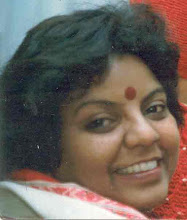
Poems by Nirupama Dutt
(Translated from the Punjabi by the poet)
Wicked Woman
If you come to my city
You are bound to find
my name in the roster
of wicked women
I have all that it takes
to be as wicked
as they come
I have a goblet
brimming over
in my hand
My laughter is known
for its abandon
Flames find a home
in my mouth
My hear beats and
every nerve does
a little dance
The road is at my feet
And just the sky above
I have the courage to bear
and express myself sans fear
Before parting
Come let’s forget the storm
that tore us from our
respective caravans
and brought us
together for the night
And to please a
fussy hotel manager
made us write
Mr. & Mrs.
before our names
Let’s forget that
tomorrow
we will
tread separate paths
in search of
yet another mirage
Tonight let’s become
babes lost in the woods
wear garlands of
wild flowers
and lose ourselves forever
in the fragrance of musk
Love
Those whom we want to love
But never get to love
We love always
Those letters
Where must those letters be?
Letters written on stormy nights
I sent to many a destination
But never got an reply
or even a confirmation…
The twelve-page-long letter
I sent to that tall giraffe-like boy
Who would sit with me till
past midnight talking much
of celibacy and D.H. Lawrence
in the same breath yet he
was afraid of the balm of touch…
So many letters after that
Some harsh some soft
In one there would be
banishment from my life
in another things
would be made all right
One letter would want
that my books be sent back
The other one would
follow a different track…
Perhaps these letters
I sent after stormy nights
to many a destination
were written to myself
Why then did I look
for a reply
or a confirmation…
5.Friends & Lovers
When friends become lovers
The friend deep down
In the heart
Gets forever lost
Look long, look hard
But the friend you knew
Is now far apart
Laughing sorrow
I will not let sorrow sit still
today in my home
Pushing it into my jhola
I will take it along
to the city streets
Today I will steal a bright red
gulmohar bloom and put it
in my hair
Borrowing smiles from the
Coffee House waiter
A little joke with the
library caretaker I will share
When all these tricks
to cheer a sorrowing day fail
I will sit on the slope
outside the girls’ hostel
and light my cigarette
the ashes will mix for sure
in my poem today
and readers will get a chance
to say I am all wrong_
“Such are the constraints of
poetesses of Amrita Pritam’s age
A cigarette is their only solace!”
Thinking of my constraints
I will be ever so pained
blaming it all on my wretched
two affairs and a half
I will go to the poet of the city
looking for life sans restraint
He will have half a bottle of rum
in one pocket and a freshly
written poem in the other
He will teach me a mantra
or two of life and reading
his new poem promise to
leave drinking for all times
I too will make a list of
good resolutions and seeking
time for just one more love
I will turn myself into words
The drifting sorrowful day will stop
look back at us and laugh
I will become a part of the magic
of making a sad day snigger
Scattering lines of sorrowing laughter
I will come away
7.Passing century
In the last few years of the century
the poem will find itself
beneath the moon of the second night
beyond the grove of the trees
sitting on a bench in the
dark corner of the park
in your fond embrace
and thus forgive the passing century
many of its sins
Keepsakes
Go away if you must
for you have
given me so much
I will have forever
this dark night
and its song
the cool water
touching our feet
as the stream moves along
Among my keepsakes
is your laughter, your words
the twittering of some
sweet and unknown birds
Your fingers will play
softly on a
melody on my dusky flesh
I will cherish every caress
With me will remain
the unanswered prayer
lying at the feet of the
grave of the
nine-yard pir-faqir
As I tread forever on
in an endless journey
on this empty path…
9. Moving city
Nothing changes really
on changing a city
Neither the empty noise of the day
Nor the screaming silence of the day
The same grey sky peeps
through the small rectangle
of the window
The blessing mumbled
in mother’s trembling voice
does not change
What changes perhaps
is the name of the lover
City to city
I have learnt well to hide
the wounds of one city
from the wounds
of anther
To change myself
just a bit
on changing a city
Laugh loudly one place
Smile softly on a
at the other
In just five hours
crossover from the
sigh of Shiv Kumar Batalvi*
to the notes of Bhimsen Joshi*
I have learnt drifting
from city to city
to forget my lost village
*Shiv Kumar Batalvi was a lyrical poet of Punjabi known for literally singing out a sigh and Bhimsen Joshi is a magical vocalist of Hindustani classical music.
Suicide
She will not think of suicide
It is difficult to devise
ways of dying
and survive the poison
with the guilt of knowing
that the money saved
for the wedding feast
was spent on
extracting the poison
Instead she will take
out the seven saris
saved over long years
in her mother’s box
and the locket with
nani’s picture, that
somehow escaped the
eyes of her drunk father,
put the bundle of her
past in the box
and go to another home
She could well be killed
there for bringing less dowry
The newspaper next day will
carry a small story of yet
another young woman dying
in a stove-burst
Growing up
She is no longer
a little girl
My daughter
is growing up
She no longer
likes to make sentences
as her mother would
She wants to do things
as she would
When her grammar
teacher asks her
to make a sentence
with the word ‘need’
My darling writes_
‘No one needs anyone
in this world’_
I look at the sentence
and think my daughter
has grown up
beyond her years
Where have the boats gone?
Where did the boats come from? O’ Ranjha*
my trader in love?
Where did the boatmen come from? O’ Ranjha
my trader in love?
My mother used to sing this
lost song of Pothohar*
I recall the boats would come
from Jehlum
and the boatmen
from Attock
My mother had seen Attock
and spent her childhood in Jehlum
For me these are just two
names of rivers and towns
lost somewhere in the Punjab
across the barbed wire
If the boats came they must have
gone somewhere too
I cannot recall the destination
mentioned in the song
Mother is no longer there
or I would ask her
Never mind I will ask Ranjha
my trader in love
if I come across him
somewhere along:
Where have the boats gone, O’ Ranjha
my trader in love?
Where have the boatmen gone, O’ Ranjha
my trader in love.
*Ranjha is the archetypal romantic and tragic hero of the famous love legend of Punjab_ Heer Ranjha. The poet belongs to a family that migrated at the time of the Partition from Pakistan Punjab to India Punjab thus the allusions to lost village, rivers and towns.
Newspaper
The morning cuppa tea
must be spiced up
with a juicy bit or two
But nothing seems
to happen
the obituary is ready
but the old ailing leader
has survived again
with dialysis
The police station reports
no murder, no suicide
No shanties have been
burnt down anywhere
No dalit* girl
has been raped
The day is passing
and there has been
no strike, no price hike
The newspaper is sad today…
*dalit means low-caste, who form the oppressed section in India
The Black Woman
The dreams of a black woman
are very fair
and her truth pitch dark
She is born with a pain
to which no colour
can be assigned
It borrows the colour of water
To fill her eyes
to swim in the red wounds
of her dark body
She suppresses on her lips
the silent screams of
every dark person and turns
darker still
The dreams of a black woman
fly away like white birds
to pick bits of moonlight
and scatter them in her lap
A black woman longs for
a fair child…
Female Friends
When female friends meet
after long years around
the old and new names
scratched on the coffee house table
their infectious laughter
will ring false the adage
that says that laughter
has but a small life
And they will be surprised
at their own capacity
to still laugh so much
The unprovoked
laughter of youth
often gets lost
in loves, homes, offices
But when they met
after long years
then once again
it will be a laughing marathon
Laughing, they will talk
of painting, poetry and fiction
And they will recall
that girl in the hostel
who pasted posters
outside the warden’s room
and raised slogans against
the insipid mess food
They will also remember
The girl who used to sing
old Hindi movie songs
till late in the night and
stealthily make tea for her friends
Now even the new songs
of those days
have become old
and the old very old
But when they meet
the difference between the old
and the new
will melt away
Trying to recognize
some names on the table
they will ask one another
Why is it that one rarely
marries for love?
And if one does then
why does the love end?
The answer to these
unanswerable queries
will be some more laughter
but not as unprovoked as
it used to be in the old days.
Mother and Me
She may have told me the story of Prince
Charming
when I was a child but it is long forgotten
Now, when I wash the day’s dust from my feet
and lie by her side, she says —
Yes blow the smoke into my face and
consider yourself lucky that your father is dead
you wouldn’t have dared to smoke before him.
Your father was a strange one indeed,
All the restrictions were meant only for
the women of the house,
Not only your father, my father was the same to
Fathers, husbands, sons — they are all alike
their species is such. It is a folly to love them.
Not one of them is to be trusted —
I disagreed with my mother and say that there must be
some man somewhere in this wide world who can be loved
and trusted but she shuts me up and says —
A great one you are to tell me that
haven’t you trusted and seen. Then you will
come back crying and wish yourself dead.
The likes of you puzzle me. What greater blasphemy
can there be to die for one of these beggars.
It is not like it was in our times. You girls
Are independent and earn your own bread, say good riddance
to these fellows and be happy —
My mother’s logic is simple, she also says —
Don’t marry to man you love, before marriage
he is a god
and after marriage, in a brick and woof house, a
demon like any other.
Why tarnish the image of a god! —
My mother has saved herself from storms by
cherishing an image of god
and I who have looked only for a man have
drifted much.
Mother doesn’t think well of men at all
She curses and criticises them but if one of her
four sons
is late in writing a letter, she hide beneath the
quilt and weeps
at nights. In the morning, she washes off her tears
and declares —
My sons are not to be blamed
The whole tribe is the same.
Sub Editor
Lost in the mass of blue letters
clicked out of the teleprinter
I the eternal sub editor
Delete, cap and uncap
with my ball-point pen
words which belong
to another.
Condemned forever to correct
and not create
I forget my impotence
temporarily
by giving a smart headline
which I will find in the paper
tomorrow with another’s name.